Are Przewalski's Horses Truly Wild?
Wild, feral, or something researchers still argue about? The takhi is the only horse never tamed, and the honest picture is more interesting than a one-word answer.
 Written with Bat-Erdene Ganbaatar, Hustai National Park tour guide and wildlife specialist
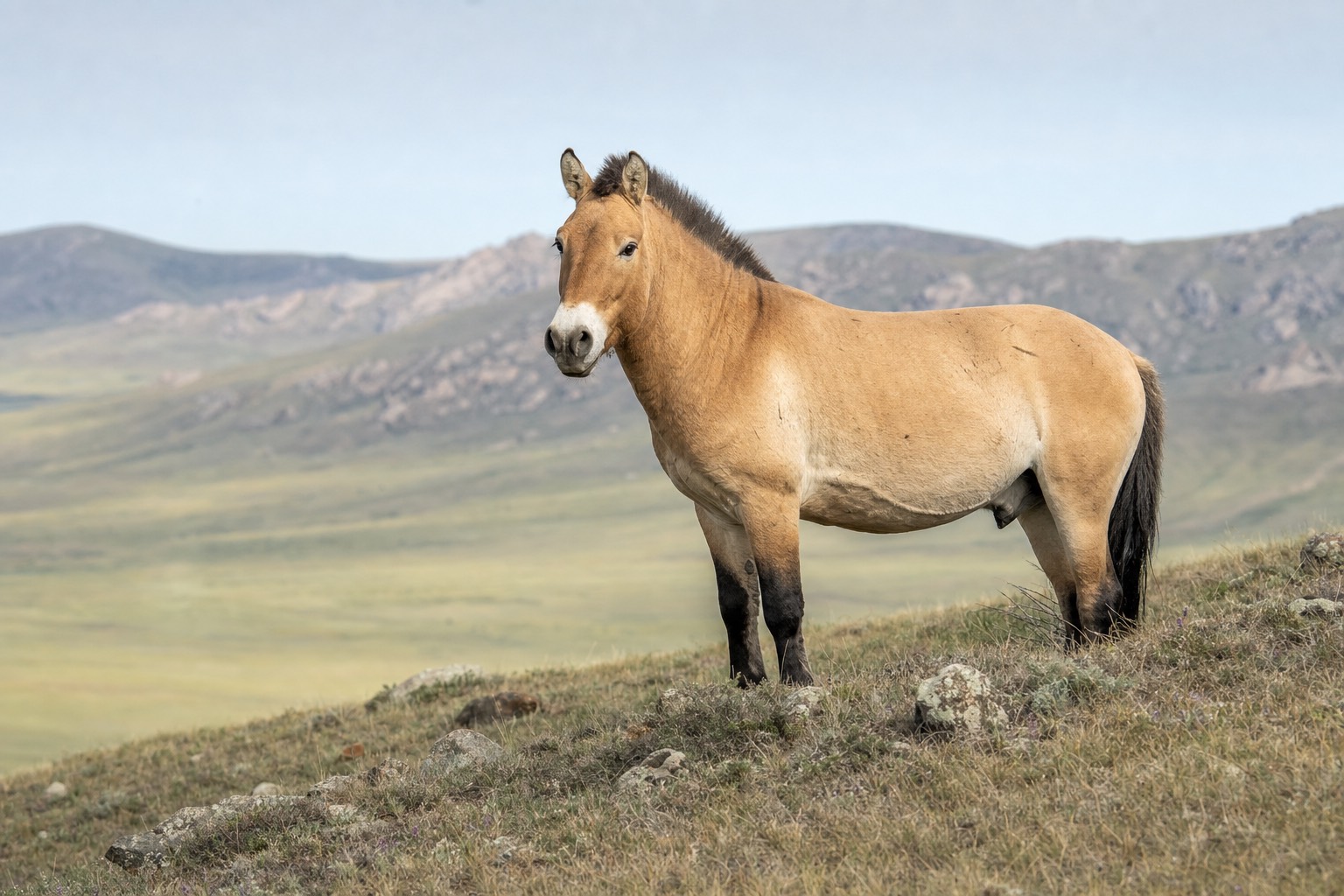
Are Przewalski's horses truly wild?
Yes. The takhi (Przewalski's horse) is the only truly wild horse left, because it was never domesticated, unlike feral mustangs that descend from escaped ranch horses. Every takhi does descend from captive-bred founders, and researchers debate its deep ancestry, but no living horse has a stronger claim to being genuinely wild.
Booking Choice: See the article's wild-versus-feral distinction in a living Hustai population on a private wildlife visit with the main logistics arranged. Explore the private Hustai visit
A guest once argued with me for the length of a drive that no horse is really wild anymore. He had a point worth taking seriously, and I have thought about it on every trip since. The takhi is not wild in the sense of an animal untouched by people. It passed through zoos and breeding books to survive at all. Yet call it feral and you would be wrong too. The honest answer sits in between, and it is more interesting than either slogan.
If seeing the behavior described here is part of your Mongolia plans, check your travel date before arranging separate transport to Hustai. This private visit includes Ulaanbaatar pickup, transport, admission, and lunch. Check your Hustai travel date
Are Przewalski's horses truly wild?
Yes, the takhi is considered the only truly wild horse because it was never domesticated. Unlike mustangs, which descend from escaped domestic horses, the takhi has no history of being bred, ridden, or worked by people. Every living takhi does descend from captive-bred founders that saved the species, and researchers debate its deep ancestry, but its wildness is real.
The word "wild" carries two meanings that get tangled here. One means an animal currently living free of human control. The other means a lineage that was never domesticated in the first place. The takhi qualifies on the second, stronger definition, which is what biologists mean when they call it the last wild horse. Its survival did run through captivity, since the species would have vanished otherwise, but captivity for conservation is not domestication. For the full biology, our complete guide to the takhi lays out why it stands apart.
There is a genuine scientific wrinkle. A 2018 genetic study proposed that the takhi may descend from horses managed by the ancient Botai culture of Kazakhstan, which would complicate the clean "never domesticated" label. Later work has pushed back, and the question is still open. The Przewalski's horse entry at Wikipedia summarises the back and forth. What no one disputes is that the takhi was never a riding or working horse in any recorded human culture, and it resists taming to this day.
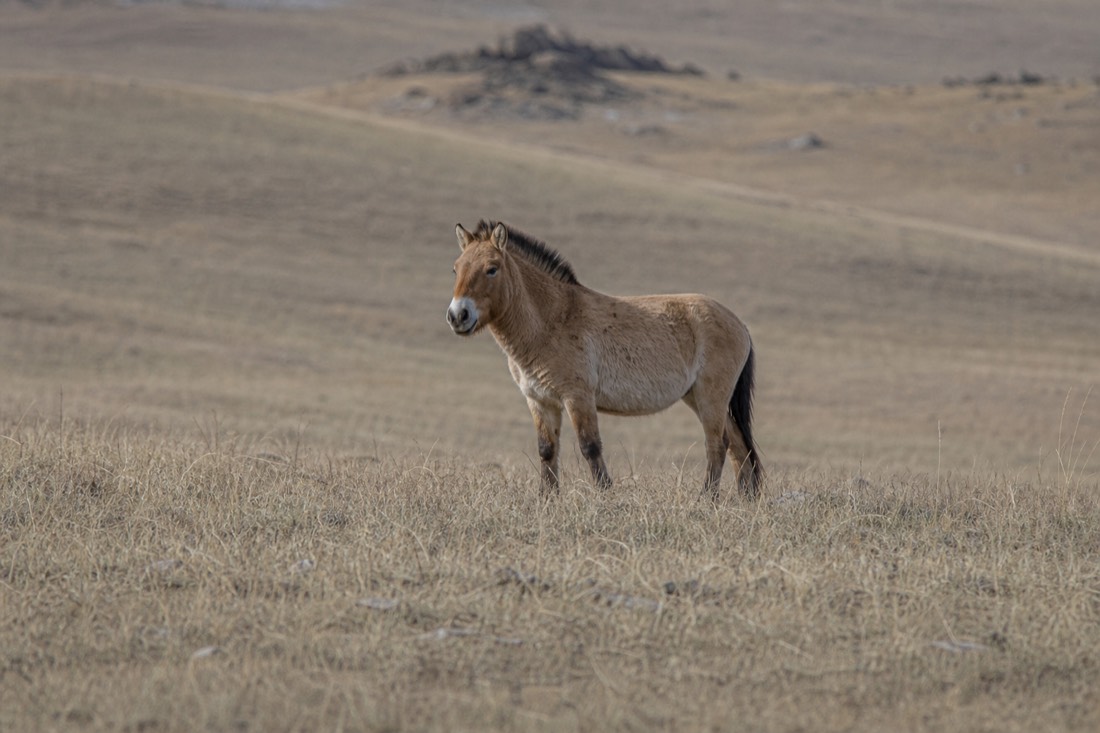
What is the only truly wild horse left in the world?
The only truly wild horse left in the world is the Przewalski's horse, or takhi. Every other free-roaming horse population, including American mustangs, Australian brumbies, and the Camargue horses of France, is feral, meaning it descends from domesticated stock. The takhi alone has no domestic lineage in its known history.
This is where the mustang comparison earns its keep. Mustangs are extraordinary animals and they live wild lives, but their ancestors were Spanish domestic horses brought to the Americas. Release a domestic animal and its descendants become feral, not wild. The distinction is not snobbery. It changes what the animal is, genetically and behaviourally.
| Population | Type | Origin | Truly wild? |
|---|---|---|---|
| Takhi (Przewalski's horse) | Wild | Never domesticated | Yes |
| American mustang | Feral | Escaped Spanish horses | No |
| Australian brumby | Feral | Escaped colonial horses | No |
| Camargue horse | Semi-feral | Domestic French stock | No |
The Smithsonian's National Zoo describes the takhi in exactly these terms, as the last remaining truly wild horse. For where you can actually watch one, see our overview of Mongolia's wild horses.
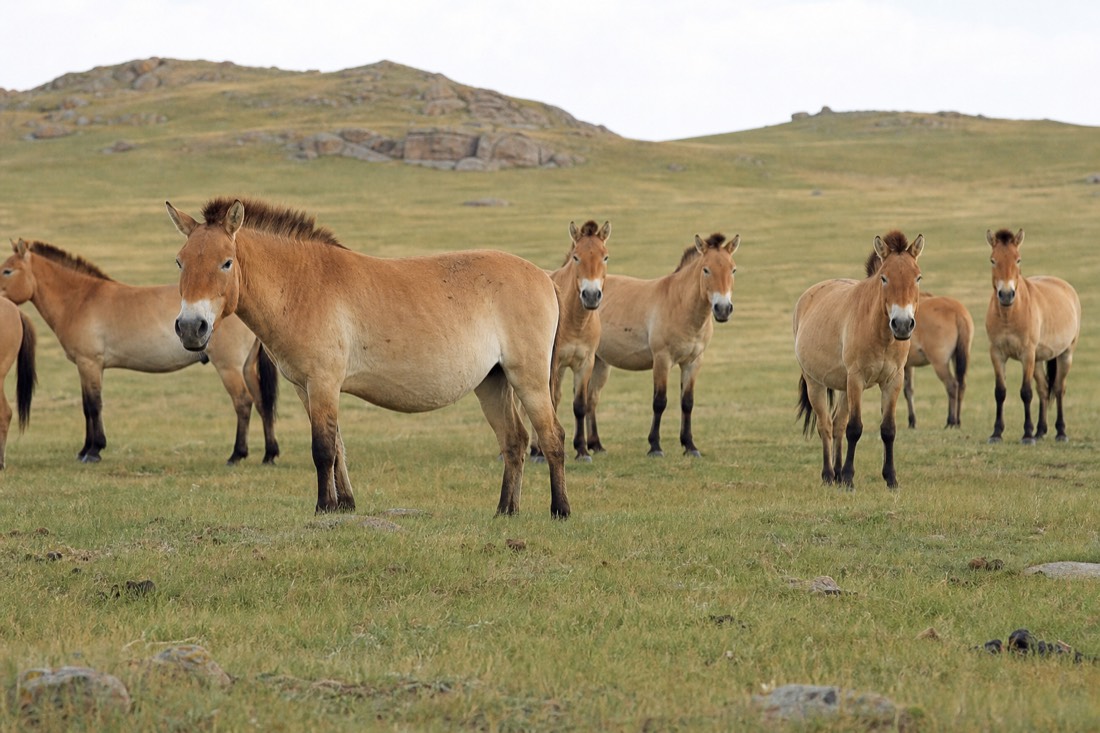
What is the rarest horse on Earth?
The Przewalski's horse is widely called the rarest wild horse on Earth, with only around 2,000 animals alive, all descended from about a dozen founders. A few critically endangered domestic breeds have fewer individuals, but the takhi is the rarest horse that is genuinely wild rather than a managed breed.
"Rarest" depends on how you count. If you include every horse category, some tiny domestic breeds run low on numbers too. But those are managed breeds, kept going by people. Among wild horses, nothing is rarer than the takhi, and its rarity is sharpened by the founder bottleneck: roughly a dozen ancestors for the whole species. That narrow genetic base is why conservationists manage takhi breeding so carefully, a point covered in our count of how many Przewalski's horses are left.
There is also a difference between rare and irreplaceable. A domestic breed with few animals can, in theory, be rebuilt from related stock. The takhi cannot, because there is no other wild horse to rebuild it from. That combination, low numbers and a one-of-a-kind lineage, is what earns it the "rarest" label in the sense that actually counts.
| "Rarest horse" claim | What it usually means | Applies to the takhi? |
|---|---|---|
| Rarest wild horse | The only never-domesticated horse, ~2,000 left | Yes |
| Rarest by lowest headcount | Some managed domestic breeds run lower | No, those are domestic |
| Most genetically bottlenecked | Descended from ~12 founders | Yes |
Why does the wild-versus-feral distinction matter?
It matters for conservation, genetics, and how we understand horses at all. A truly wild species carries an ancestral genome that no domestic or feral horse can replace, which makes the takhi irreplaceable rather than just rare. Protecting it preserves a lineage that split off before humans ever tamed a horse.
This is not a word game for biologists to enjoy. Feral horses, however striking, are recoverable in principle, since their domestic ancestors still exist. Lose the takhi and you lose the only window onto what a genuinely undomesticated horse is: how it behaves, how its harems organise, what its unaltered genome looks like. That is why the species sits inside strict reserves with guided access and enforced viewing distances, rather than being managed like feral herds that are sometimes culled or rounded up.
The distinction also shapes expectations on the ground. Visitors who picture a tame petting-zoo animal are surprised by how remote the takhi keeps itself. There is no bond with people to draw on, no shared history of handling, and that wariness is itself the proof of wildness. When a harem lifts its heads and moves off at 250 metres, you are watching an animal that owes humans nothing.
What evidence backs the takhi's wildness?
The evidence is behavioural, genetic, and historical. The takhi has never been tamed or ridden despite attempts, it carries 66 chromosomes against the domestic horse's 64, and no human culture recorded it as a working animal. The one counterpoint, the Botai ancestry hypothesis, remains debated rather than settled.
On the ground, the behaviour is the clearest proof. Approach a takhi harem on foot and it leaves, every time. There is no herd instinct toward people, no history of handling to fall back on. The genetics add a separate chromosome count and a distinct lineage. Against all that sits one contested study, which is why the careful phrasing is "researchers debate," not "case closed."
It helps to weigh the counterpoint honestly rather than wave it away. The Botai hypothesis, if it ever held up fully, would recast the takhi as a very ancient feral horse rather than a never-touched one. Even then, the takhi would still be the closest thing we have to a wild horse, separated from any domestic breed by thousands of years and a different chromosome count. Later genetic work has largely walked the strongest version of the claim back, and the mainstream position remains that the takhi was never domesticated in any meaningful sense. So the debate refines the story rather than overturning it.
| Evidence | What it shows |
|---|---|
| Never tamed or ridden | No domestication in recorded history |
| 66 chromosomes vs 64 | A distinct lineage from domestic horses |
| Flees human approach | No handling instinct |
| Botai hypothesis (2018) | The one debated counterpoint |
The clearest way to judge for yourself is to watch a harem behave.
The takhi's current conservation status is logged on the IUCN Red List, which lists it as endangered. Read that alongside the Smithsonian and Wikipedia entries and the picture holds: genuinely wild, genuinely rare, and still recovering.
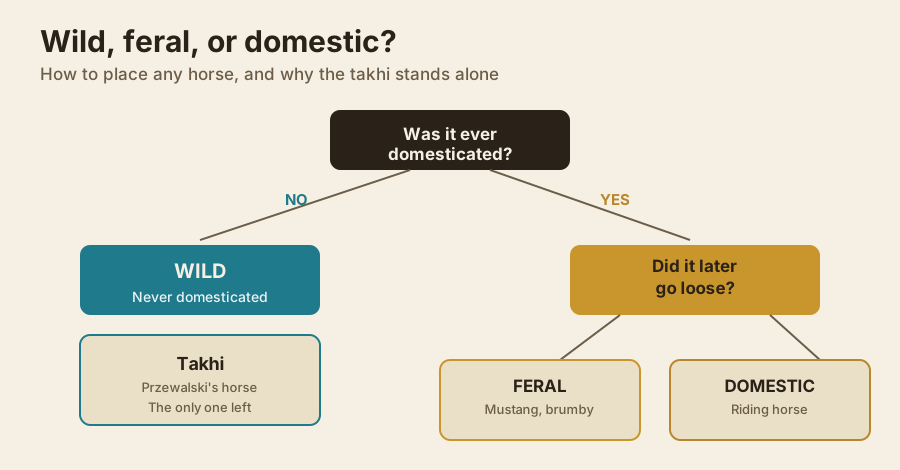
What exactly separates a wild animal from a feral one from a domestic one?
Wild means a lineage that was never brought under human control. Feral means domestic stock that escaped or was released and now breeds on its own. Domestic means an animal actively bred and kept by people. The takhi is wild by that strict definition; almost every other free-roaming horse on Earth is feral.
These three words get used loosely in everyday conversation, which is exactly how the confusion starts. A feral population can look just as untamed as a wild one from a car window, since both graze without a fence or a halter in sight. The difference sits in the genome and the history, not the current behaviour. A feral mustang could, in principle, be caught and retrained to carry a rider, because that capability is still sitting in its domestic ancestry. A takhi cannot, because that capability was never there to begin with.
| Term | Definition | Genetic or lineage marker | Example | Can be ridden? |
|---|---|---|---|---|
| Wild | Never brought under human control | Distinct lineage, no domestic ancestry | Takhi | No |
| Feral | Domestic stock gone loose, breeding on its own | Descended from a domesticated lineage | Mustang, brumby | Yes, if re-tamed |
| Domestic | Actively bred and kept by people | Selectively bred lineage | Mongolian riding horse | Yes |
The Camargue horse of southern France sits in an interesting middle ground worth mentioning, since it complicates the neat three-way split. It is technically semi-feral, roaming in loose herds across the wetlands, yet it descends from a managed domestic breed and is regularly rounded up, branded, and trained by local herders. That mix of freedom and human management is exactly what the takhi is not. A takhi harem answers to nobody, follows no branding season, and has never once been herded into a corral for anything but its own conservation.
What is the Botai lineage debate, and does it actually change the takhi's wild status?
A 2018 genetic study proposed that the takhi may descend partly from horses managed by the ancient Botai culture of Kazakhstan, which would complicate a simple "never domesticated" label. Subsequent genetic research has walked back the strongest version of that claim, and the mainstream position still holds the takhi apart from every domestic lineage.
The Botai culture, a Copper Age society in what is now northern Kazakhstan, is central to the archaeology of horse domestication and has its own detailed Wikipedia entry worth reading if the debate interests you. The 2018 study that stirred this up used ancient DNA to argue for a Botai connection to the takhi lineage. It is a serious piece of research, not a fringe claim, which is why this guide does not wave it away. But later genetic work has pushed back hard on the strongest version of that interpretation, and the behavioural evidence never moved an inch either way: no culture, Botai included, left any record of riding or working a takhi as we know the species today.
| Position | What it argues |
|---|---|
| 2018 genetic study | Takhi may partly descend from horses managed by the Botai culture |
| Subsequent genetic research | Walks back the strongest version of the Botai-ancestry claim |
| Behavioural record | No culture, ancient or modern, recorded taming or riding a takhi |
| Working conclusion in this guide | The debate refines deep ancestry; it does not overturn the never-domesticated case |
Even in the most Botai-friendly reading of the evidence, the takhi would still be separated from any modern domestic horse by thousands of years and a distinct chromosome count. The debate is genuinely open among researchers, and honest coverage of the topic should say so rather than pretend the question is closed in either direction.
What makes this debate hard to settle is the depth of time involved. The Botai culture predates written history in the region by millennia, so researchers are reconstructing a relationship between people and horses from bone fragments, ancient DNA, and archaeological context rather than any direct record. That is genuinely difficult science, and reasonable researchers can and do read the same evidence differently. This guide's position is not that the debate is settled in the takhi's favour, but that even the most serious challenge to the "never domesticated" label has not produced a domesticated takhi anyone has ever ridden, worked, or kept as livestock.
Does captive breeding for conservation count as a kind of domestication?
No. Captive breeding preserves a wild lineage's genetics for future release, with no selection for tameness, no riding, and no working use. Domestication actively reshapes an animal over generations for human purposes. The two processes share a location, a zoo or breeding centre, but not a goal.
This question comes up more than you might expect, usually framed as "but they were bred in zoos, so surely that counts for something." It is a fair thing to ask, and the answer is no for a specific reason: nobody selected takhi for calmness around people, for a rideable temperament, or for any trait that would make the species more useful to humans. Breeders paired horses to preserve genetic diversity and produce animals fit to survive on the open steppe, which is the opposite goal from domestication.
| Aspect | Captive conservation breeding (the takhi) | Domestication |
|---|---|---|
| Goal | Preserve wild genetics for reintroduction | Breed traits suited to human use |
| Taming attempted | No | Yes, historically, over generations |
| Selection pressure | Genetic diversity within a managed population | Selection for docility and useful traits |
| Outcome | A genetically wild lineage kept alive | A new domestic lineage created |
The distinction shows up clearly the moment a captive-bred takhi is released back onto open ground. A domesticated animal released into the wild after generations of breeding for docility often struggles to survive without human support, because the traits that made it useful to people are frequently the opposite of what keeps a wild animal alive. Reintroduced takhi did the opposite: horses bred in European zoos for decades were released onto the Mongolian steppe from 1992 onward and re-established fully wild, self-sufficient harems within a few generations. That outcome only makes sense if the underlying wildness, the instincts, the wariness, the herd behaviour, had never actually been bred out of the species in the first place. It is the single clearest piece of evidence this guide can offer, stronger in some ways than any genetic marker, because it is a result you can observe directly in a living, self-sufficient wild population.
How does a Hustai takhi actually behave differently from a domestic horse, day to day? Bat-Erdene's view
Guiding here since 2022, I watch for the same tells every visit: a takhi never relaxes fully around a vehicle, a stallion's warning posture is unmistakable once you have seen it, and a harem moves as a unit the instant it decides to leave, none of which a domestic horse does around people it knows.
A domestic horse in a paddock will often walk toward a person out of curiosity or habit. A takhi never does that. The closest I have seen is mild tolerance at a fixed distance, and even that erodes fast if the vehicle creeps closer than the harem is comfortable with. The clearest warning sign is a stallion pinning his ears back and lowering his head toward whatever he has decided is a threat, a posture I point out to every group so nobody mistakes it for curiosity. When a harem does decide to move, it moves together, mares and foals first, the stallion often covering the rear, a coordinated retreat that looks nothing like a domestic herd drifting off toward better grass.
| Behaviour cue | What a takhi does | What a domestic horse around people usually does |
|---|---|---|
| Approach by a vehicle or person | Holds distance, watches, ready to leave | Often approaches out of curiosity or habit |
| Warning display | Ears back, head low, unmistakable | Rare around familiar people |
| Group movement | Whole harem leaves together, coordinated | Individual horses may linger or approach separately |
| Baseline comfort with people | None; distance is constant | Learned comfort, varies by handling |
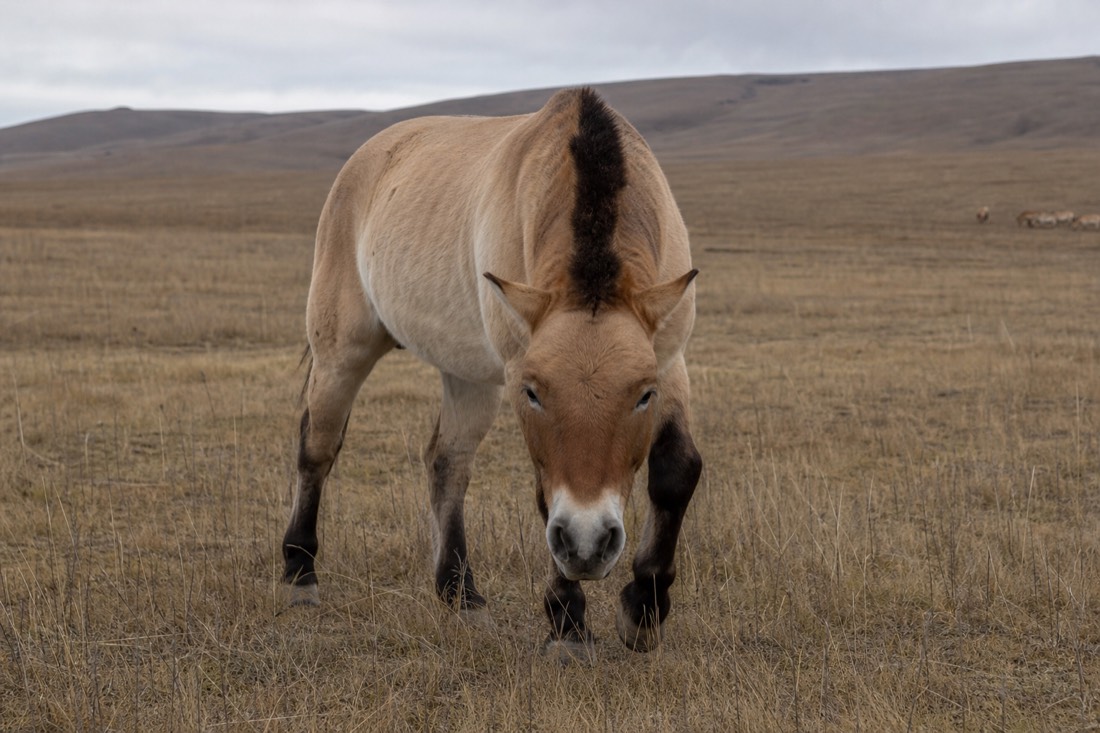
New guides sometimes need a season or two before they trust their own read of these cues, and I still tell mine what I tell every group I take out myself: watch the ears and the head height before you watch anything else. A relaxed takhi grazes with its head down and ears loosely tracking sound in different directions. The instant both ears lock forward on the vehicle and the head lifts fully, that is the animal deciding whether you are a problem, and it is the moment to stop moving closer, not the moment to reach for a better photo angle.
Frequently asked questions about the takhi's wildness
Is the takhi really the only wild horse? Yes, in the strict sense. It is the only living horse that was never domesticated. All other free-roaming horses are feral descendants of domestic stock.
Does the Botai study mean the takhi is not wild? Not really. The 2018 study raised a debated question about deep ancestry, but no culture ever domesticated the takhi as a working horse, and researchers continue to argue the point.
Why are mustangs not truly wild? Because they descend from escaped Spanish domestic horses. They live wild lives but carry a domestic lineage, which makes them feral rather than wild.
Is the takhi the rarest horse on Earth? It is the rarest genuinely wild horse, with about 2,000 left. Some managed domestic breeds have fewer animals, but they are not wild.
Choose Your Next Step
Private Hustai Wildlife Day
Have your travel date in mind? Check Private Hustai Wildlife Day before arranging the rest of your trip.
8 to 10 hours. Private transport, lunch and park admission; pickup offered from Ulaanbaatar. English, French, Korean or Russian. Wildlife and a dawn departure are not guaranteed. Not wheelchair accessible; not recommended during pregnancy.
Compare Trip Styles And Adjust Your Choice
- Six-Hour Hustai Day: About 6 hours. Downtown Ulaanbaatar hotel transfers, local lunch, entrance and an English- or Mongolian-speaking guide. Not suitable for mobility impairments. Sightings are not guaranteed. Arrange your own travel insurance.
- Two-Day Hustai And Nomadic Homestay: Two days with a private ger at a nomadic family, meals and Ulaanbaatar hotel pickup. English guiding. This is not either named Hustai tourist camp. Riding and the cultural show cost extra. Not wheelchair accessible.
This is trip guidance, not an eligibility or availability confirmation. Check the operator's restrictions for everyone travelling.
Choose a date to inspect the Viator departure schedule. Final availability and price are confirmed on Viator.